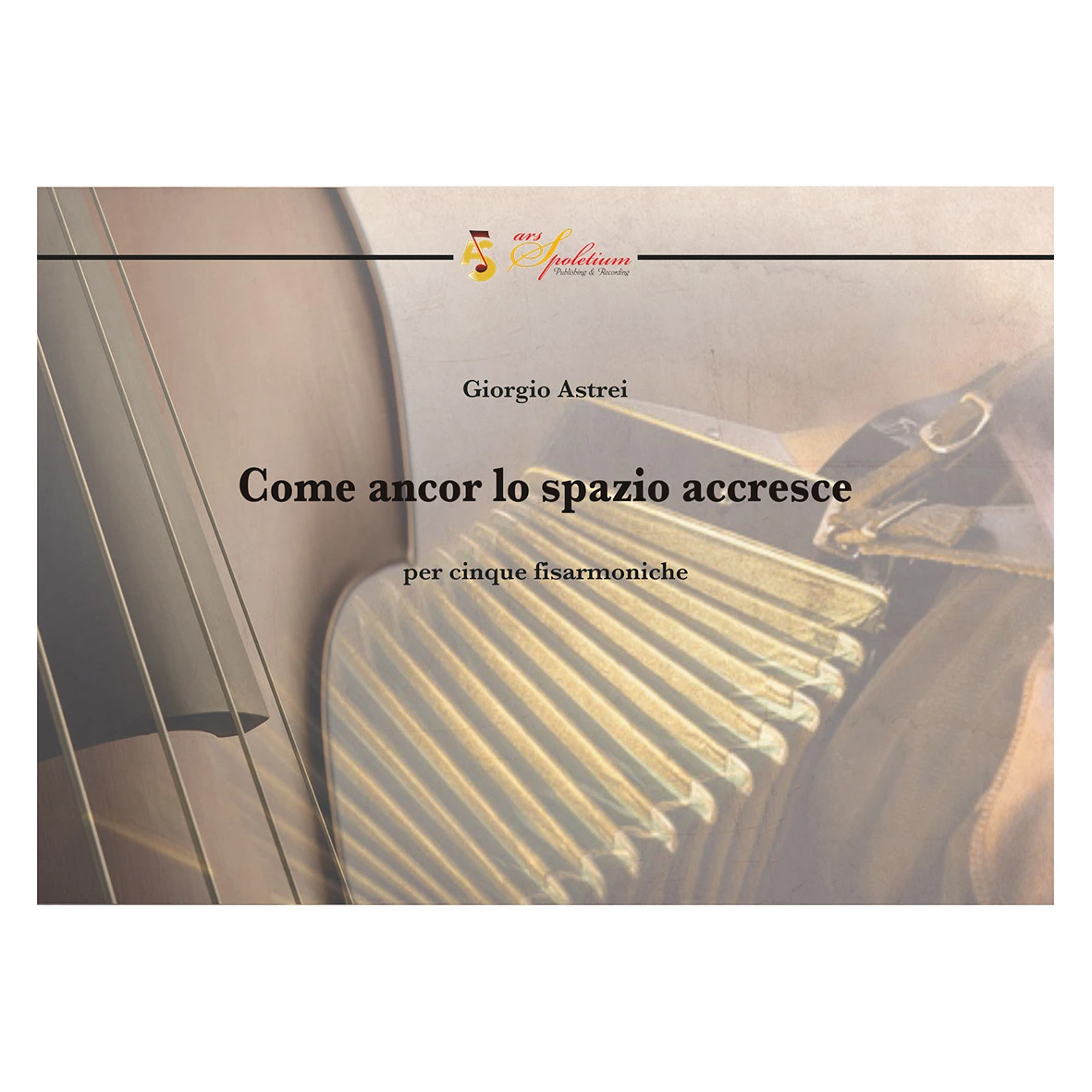
Come ancor lo spazio accresce (per cinque fisarmoniche)
15,00 €
Il discorso musicale presentato dal brano si sviluppa attorno al ricordo del quartetto op. 131 di Ludwig van Beethoven. L’omaggio rivolto, per quest’anno celebrativo, nasce dopo un approfondito studio delle scelte compositive e dei materiali beethoveniani, dall’immediato legame dello straordinario impatto sonoro dell’ensemble fisarmonicistico con quello degli ultimi quartetti.
(LA PARTITURA IN OGGETTO È DISPONIBILE SOLO NELLA VERSIONE PDF)
The piece develops around the memory of Ludwig van Beethoven’s quartet op.131. This homage has been realized for Beethoven’s celebratory year, and it derives from the close link between the accordion ensemble’s extraordinary sound impact with that of the latest quartets.
(ONLY PDF VERSION)
Il discorso musicale presentato dal brano si sviluppa attorno al ricordo del quartetto op. 131 di Ludwig van Beethoven. L’omaggio rivolto, per quest’anno celebrativo, nasce dopo un approfondito studio delle scelte compositive e dei materiali beethoveniani, dall’immediato legame dello straordinario impatto sonoro dell’ensemble fisarmonicistico con quello degli ultimi quartetti. A questo riferimento musicale si aggiunge il sonetto XXIXb de “I Sonetti ad Orfeo” di Rainer Maria Rilke. Questo componimento ha affiancato lo studio del quartetto e l’intero processo compositivo creando così un unicum irripetibile.
“[…] Geh in der Verwandlung aus und ein […]”
“[…] Nella metamorfosi entra ed esci […]”
Il soggetto di fuga del primo movimento assieme ad un passaggio estrapolato dall’ultimo nel quale i quattro archi si ritrovano ad oscillare vorticosamente su due armonie, vengono rielaborati e ri-presentati. Sono sempre presenti, a volte nascosti a volte palesi. Intorno a questi concetti opposti, canto/armonia – uno/tutti, si sviluppa la prima parte del brano. Il contrasto non avviene mai da un punto di vista formale ma tutto è in un continuo divenire e il flusso di coscienza viene portato avanti senza bruschi cambiamenti, vi sono solo lievi deviazioni alla ricerca di un percorso già tracciato.
“[…] Sei in dieser Nacht aus Übermaß / Zauberkraft am Kreuzweg deiner Sinne, […]”
“[…] Sii in questa notte della dismisura / magica forza all’incrocio dei tuoi sensi […]”
La forza magica dei sensi è racchiusa in uno statico corale che attenua la pulsione della prima parte. Le ferme armonie sospirano e prendendo fiato, si espandono allontanandosi sempre più dalle proprie origini.
“Stiller Freund der vielen Fernen, fühle, / wie dein Atem noch den Raum vermehrt. […]”
“Silenzioso amico di molte lontananze, senti, / come il tuo respir ancor lo spazio accresce […]”
Il sentiero ora è visibile, il ricordo è completo. Così una nuova e più ampia citazione si instaura inamovibile, diventando cammino da seguire. Il breve sesto movimento del quartetto viene esposto completamente e la metamorfosi si capovolge.
“[…] zu der stillen Erde sag: Ich rinne. / Zu dem raschen Wasser sprich: Ich bin.”
“[…] di’ alla terra immota: io scorro / Alla rapida acqua: io sono.”
Completato il tragitto ci si rende conto che l’arrivo è un ritorno. I materiali nuovi e antichi danno origine ad una nuova sintesi dove il nuovo è vecchio ed il vecchio è nuovo.
Il duecentocinquantesimo anniversario afferma a gran voce l’incredibile attualità di Beethoven e come la sua straordinaria modernità possa tuttora scorrere e pulsare nella nostra vita. Ad ogni suono, ad ogni ascolto e ad ogni passaggio la sua opera afferma: “Ich bin”.
Silenzioso amico di molte lontananze, senti,
come il tuo respiro ancor lo spazio accresce.
Nella tramatura d’oscuri ceppi di campana
abbandonati e risuona. Ciò che ti consuma,
diventa forza per questo nutrimento.
Nella metamorfosi entra ed esci.
Qual è in te l’esperienza più dolente?
Se ti è amaro il bere, diventa vino.
Sii in questa notte della dismisura
magica forza all’incrocio dei tuoi sensi,
senso del loro incontro strano.
E se terrestrità ti ha dimenticato,
di’ alla terra immota: io scorro.
Alla rapida acqua parla: io sono.
Rainer Maria Rilke
I Sonetti ad Orfeo
XXIXb
—————————————————————–
The piece develops around the memory of Ludwig van Beethoven’s quartet op.131. This homage has been realized for Beethoven’s celebratory year, and it derives from the close link between the accordion ensemble’s extraordinary sound impact with that of the latest quartets. The op. 131’s musical reference is enriched by Rainer Maria Rilke’s sonnet XXIXb of “The Sonnets to Orpheus” which not only supported the quartet’s study and the entire creative process but it mostly generated an unrepeatable unicum.
“[…] Geh in der Verwandlung aus und ein […]”
“[…] Come and go with metamorphosis. […]”
The fugue subject of the first movement and a harmonic passage extrapolated from the last movement, in which the four strings are found to swing swirling on two harmonies, are reworked and re-presented. They are always present, sometimes hidden, sometimes in the foreground. Around these opposite concepts, song / harmony – one / all, the first part of the piece develops. The contrast never occurs from a formal point of view but everything is in a continuous evolution and the stream of consciousness is carried forward without sudden changes, there are only slight deviations in search of an already traced path.
“[…] Sei in dieser Nacht aus Übermaß / Zauberkraft am Kreuzweg deiner Sinne, […]”
“[…] In this huge night, become the magic at the crossways of your senses. […]”
This magical force is contained in a static moment as a coral to mitigate the strong and the impulse of the first part. The fixed harmonies sigh and take a breath, they expand moving further and further away from their origins.
“Stiller Freund der vielen Fernen, fühle, / wie dein Atem noch den Raum vermehrt. […]”
“Silent friend of many distances, feel / how your breath is enlarging space […]”
The path is now visible, the memory is complete. A new and broader quotation is established immovable, becoming the road to follow. The short sixth movement of the quartet is fully exposed but now the metamorphosis is reversed.
“[…] zu der stillen Erde sag: Ich rinne. / Zu dem raschen Wasser sprich: Ich bin.”
“[…] say to the quiet earth: I flow. / Speak to the rushing water — say: I am.”
After completing the journey, you realize that the arrival is a return. The new and old materials give rise to a new synthesis where the new is old and the old is new.
The two hundred and fiftieth anniversary affirms loudly the incredible relevance of Beethoven and how his extraordinary modernity can still flow and pulsate in our lives. At each sound, at each listening, at each passage his work states: “Ich bin”.
Silent friend of many distances, feel
how your breath is enlarging space.
Among the rafters of dark belfries
let yourself ring. What preys on you will
strengthen from such nourishment.
Come and go with metamorphosis.
What’s your most painful experience?
If what you drink’s bitter, turn to wine.
In this huge night, become
the magic at the crossways of your senses.
Be what their strange encounter means.
And if the earthly forgets you,
say to the quiet earth: I flow.
Speak to the rushing water — say: I am.
Rainer Maria Rilke
The Sonnets to Orpheus
XXIXb