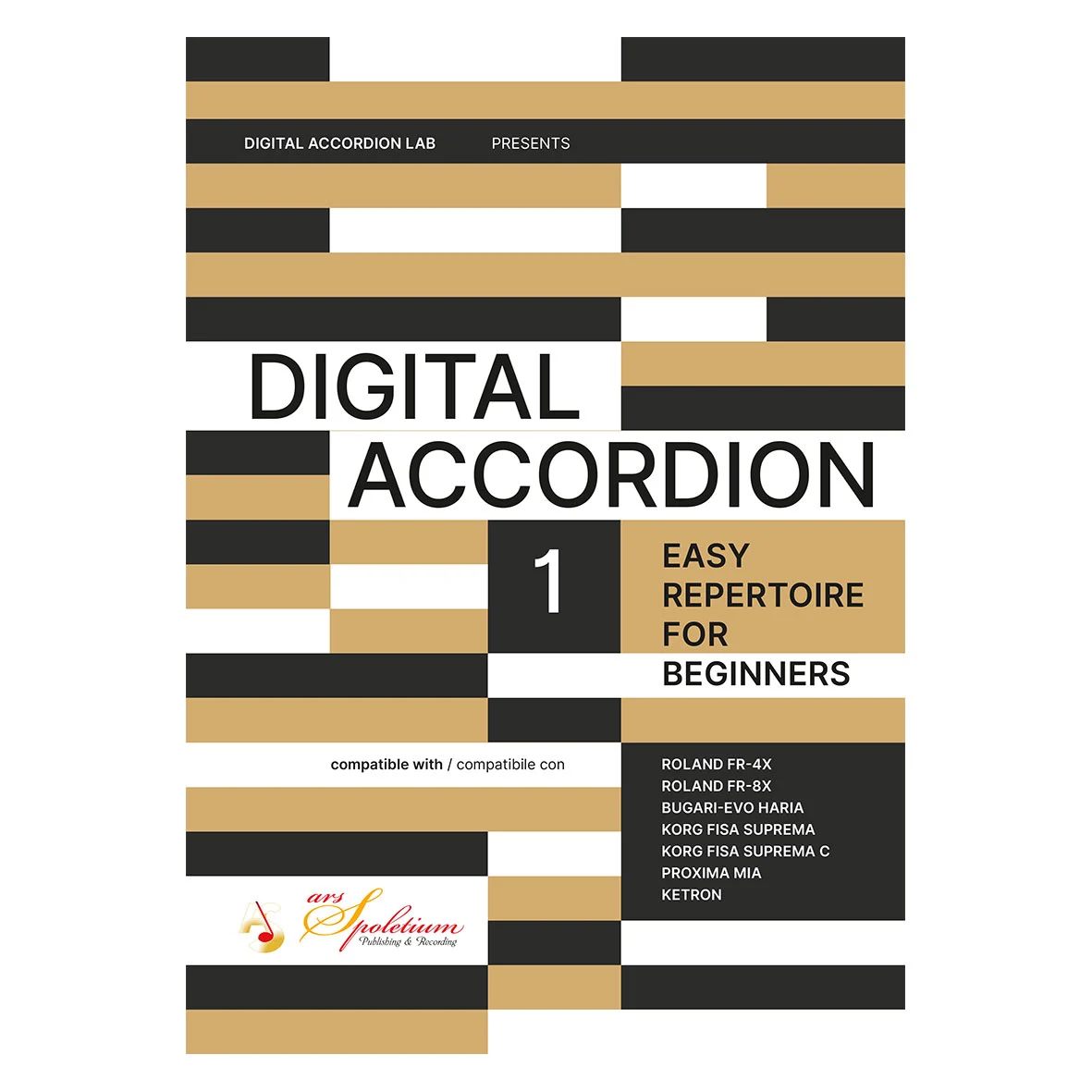
Digital Accordion 1 – Easy repertoire for beginners
15,00 €
Digital Accordion 1 stems from the need for a ready-to-use repertoire—hitherto missing for the digital accordion, yet essential to introduce musicians to this instrument. The DAL work-ing group, embodied in this case by the authors of the transcriptions (Stefano Arato, Michele Bracciali, Paolo Camporesi, Anselmo Petrosino, and Massimo Pitzianti), wanted to address the basic level as a first step, proposing easy pieces taken from educational collections and from famous repertoire appropriately adapted, such as Strauss’s Annen Polka or Vivaldi’s Spring. The real innovation is found by scanning the QR code inside the book. The webpage linked to it contains dedicated folders for each digital accordion model mentioned on the cover, featuring the sound programs prepared by the authors for each piece, a technical index describing the chosen instrumentation, and any explanatory notes.
Digital Accordion 1 nasce dall’esigenza di un repertorio di pronto uso, finora assente per la fisarmonica digitale, ma necessario per avvicinare i musicisti a questo strumento. Il gruppo di lavoro DAL, incarnato in questo caso dagli autori delle trascrizioni (Stefano Arato, Michele Bracciali, Paolo Camporesi, Anselmo Petrosino e Massimo Pitzianti), ha voluto come primo step occuparsi del livello base, proponendo brani facili tratti da raccolte didattiche e dal repertorio celebre opportunamente adattato, come Annen Polka di Strauss o la Primavera di Vivaldi. La vera novità si trova inquadrando il codice QR presente nel testo. La pagina web ad esso collegata contiene cartelle dedicate a ciascun modello di fisarmonica digitale citato in copertina, contenenti i programmi sonori preparati dagli autori per ogni brano, un indice tecnico che descrive la strumentazione scelta ed eventuali note esplicative.
DAL – Digital Accordion Lab is an association dedicated to the investigation, research, development, and promotion of the digital accordion. All its members are all highly trained musicians, currently active in their careers as teachers, transcribers, or concert artists at the forefront of the Italian accordion scene.
The DAL project stems from an idea by Sergio Scappini, a pioneering professor, scholar, concert performer, and promoter of the digital accordion, who successfully established a dedicated teaching chair at the “Giuseppe Verdi” Conservatory in Milan. DAL’s areas of action include the production of audio-visual material, sheet music for educational and concert purposes, and essays on the instrument, featuring historical and technical columns and articles in major industry magazines. As the culmination of our educational and transcription work, we are proud to present our first official publication: Digital Accordion 1 – Easy repertoire for beginners. This is a short anthology of easy piece transcriptions, complete with software files for instrument setup. With this release, a true anthological textbook series comes to life, creating a repertoire capable of accessing the digital sound library to fully exploit the instrument’s potential.
Digital Accordion 1 stems from the need for a ready-to-use repertoire—hitherto missing for the digital accordion, yet essential to introduce musicians to this instrument. The DAL work-ing group, embodied in this case by the authors of the transcriptions (Stefano Arato, Michele Bracciali, Paolo Camporesi, Anselmo Petrosino, and Massimo Pitzianti), wanted to address the basic level as a first step, proposing easy pieces taken from educational collections and from famous repertoire appropriately adapted, such as Strauss’s Annen Polka or Vivaldi’s Spring. The real innovation is found by scanning the QR code inside the book. The webpage linked to it contains dedicated folders for each digital accordion model mentioned on the cover, featuring the sound programs prepared by the authors for each piece, a technical index describing the chosen instrumentation, and any explanatory notes. These programs, installed according to the procedures described in their respective manuals, are to be considered like traditional “registers”: they change the sound of the accordion or perhaps, in the case of the digital accordion, it would be more accurate to say they literally change the instrument itself. The programs/registers are numbered according to this volume’s index and must be “recalled” during the performance, following the numerical symbols in the score. The pieces can be played on both piano and button-system accordions. Given the multiple fingering options and the diverse construction systems that the button system offers, the authors preferred to provide only the piano fingering, leaving it to each individual teacher to select the button fingering that best aligns with their own teaching methods. The DAL team wishes the musician-reader sincere enjoyment in studying this short volume and looks forward to seeing you in the next publication.
Patrizio Castelli, DAL Writer Editor-in-Chief
I play the accordion because – as Mister G would have said – someone told me to… and, even though my musical education wasn’t exclusively focused on the accordion, I am still playing it today! For over fifty years, I have also been “having fun” with the electronic accordion: it has always provided me with new incentives. Likely due to my childhood musical training, which leaned toward the symphonic, I find myself increasingly drawn to its tonal differences and the diverse blends that stem from them. Over the last twenty years, with the advent of digital technology, and firmly convinced that tech has now achieved remarkable results, I wanted to create the right conditions to share and spread this passion of mine. Someone picked up the mantle. This short anthology is the first example of a publication specifically dedicated to the digital accordion. Above all, however, it is the first tangible result of a journey—long, I hope, and certainly windin —that an “ensemble of willing volunteers” (DAL) has decided to undertake to support and promote the instrument. To them, the heirs of this modest heritage, goes my deepest gratitude and my warmest wishes for a joyful musical life.
Sergio Scappini, DAL Founder & Creator
———————————————-
DAL – Digital Accordion Lab è un’associazione che ha la fisarmonica digitale come oggetto di indagine ricerca, sviluppo e promozione. Gli associati sono tutti fisarmonicisti con importante formazione musicale, attualmente in carriera come insegnanti, trascrittori o concertisti ai primi posti del panorama fisarmonicistico italiano. Il progetto DAL sorge da un’idea di Sergio Scappini, docente pioniere, studioso, concertista e promotore della fisarmonica digitale fino all’apertura di una cattedra di insegnamento presso il Conservatorio “Giuseppe Verdi” di Milano. Tra gli ambiti di azione di DAL troviamo la produzione di materiale audio-video, di spartiti a fine didattico e concertistico e di saggistica sullo strumento, con rubriche e articoli storici e tecnici sulle principali riviste del settore. Come summa del lavoro didattico e di trascrizione, ci pregiamo di presentare la prima pubblicazione ufficiale: Digital Accordion 1 – Easy
repertoire for beginners, piccola antologia di trascrizioni di brani facili, completa di file per il settaggio dello strumento. Con questa uscita, prende concretezza una vera e propria manualistica antologica per la creazione di un repertorio in grado di accedere alla libreria di suoni digitali per sfruttare tutte le potenzialità dello strumento.
Digital Accordion 1 nasce dall’esigenza di un repertorio di pronto uso, finora assente per la fisarmonica digitale, ma necessario per avvicinare i musicisti a questo strumento. Il gruppo di lavoro DAL, incarnato in questo caso dagli autori delle trascrizioni (Stefano Arato, Michele Bracciali, Paolo Camporesi, Anselmo Petrosino e Massimo Pitzianti), ha voluto come primo step occuparsi del livello base, proponendo brani facili tratti da raccolte didattiche e dal repertorio celebre opportunamente adattato, come Annen Polka di Strauss o la Primavera di Vivaldi. La vera novità si trova inquadrando il codice QR presente nel testo. La pagina web ad esso collegata contiene cartelle dedicate a ciascun modello di fisarmonica digitale citato in copertina, contenenti i programmi sonori preparati dagli autori per ogni brano, un indice tecnico che descrive la strumentazione scelta ed eventuali note esplicative. Tali programmi, installati secondo le procedure descritte nei rispettivi manuali, sono da considerarsi come i tradizionali “registri”, essi cambiano il suono della fisarmonica o, forse, nel caso della fisarmonica digitale, sarebbe meglio dire che cambiano letteralmente strumento. I programmi/registri sono numerati secondo l’indice di questo volume e andranno “richiamati” nel momento dell’esecuzione, seguendo i simboli numerici nel testo. I brani possono essere suonati con fisarmoniche a sistema pianoforte e bottoni. Date le molteplici possibilità di diteggiatura e i molteplici sistemi costruttivi che il sistema a bottoni offre, gli autori hanno preferito proporre solo la diteggiatura a pianoforte affidando ad ogni insegnante la possibilità di scegliere la diteggiatura a bottoni più aderente alla propria didattica. Il team DAL augura al musicista lettore sincero divertimento nell’affrontare lo studio di questo breve volume e dà appuntamento alla prossima pubblicazione.
Patrizio Castelli, Caporedattore DAL
Suono la fisarmonica perché – avrebbe recitato il Signor G – qualcuno me lo aveva detto… e, anche se il mio percorso didattico non è stato esclusivamente fisarmonicistico, suono la fisarmonica ancora oggi! Da più di cinquant’anni mi “diverto” anche con la fisarmonica elettronica: mi ha sempre dato stimoli diversi e, probabilmente per la mia formazione musicale infantile, tendenzialmente sinfonica, sono sempre più attratto dalle differenze timbriche e dalle diverse miscellanee che ne derivano. Negli ultimi vent’anni, con l’avvento del digitale, convinto che la tecnologia abbia raggiunto risultati apprezzabili, ho voluto creare i presupposti per condividere e diffondere questa mia passione. Qualcuno l’ha raccolta. Questa piccola antologia è il primo esempio di pubblicazione specificamente dedicata alla fisarmonica digitale, ma soprattutto è il primo risultato concreto di un percorso – spero – lungo, sicuramente tortuoso, che un “ensemble di volenterosi volontari” (DAL) ha deciso di intraprendere per il sostegno e la diffusione della fisarmonica digitale. A loro, eredi di questo piccolo patrimonio, il più sentito ringraziamento e il più affettuoso augurio per una sorridente vita musicale.
Sergio Scappini, ideatore e fondatore DAL